
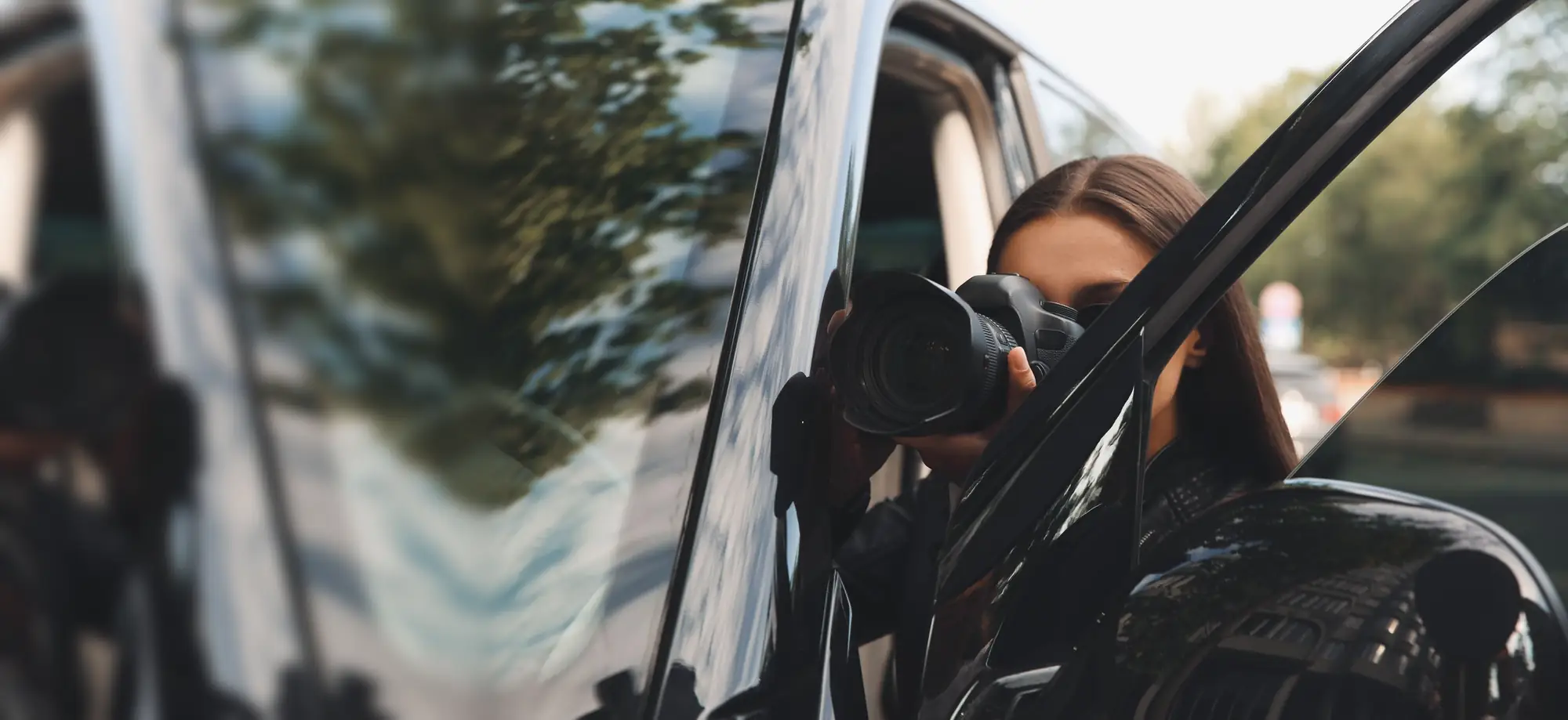

In investigations of fraud, theft, wrongful default or trust issues factual evidence is indispensable. Santos Recherchebureau specializes in dynamic observation - a flexible investigative method in which persons or vehicles are followed discreetly.
Through the use of experienced investigators, technology and real-time communication, we deliver objective reports with factual findings, which can be used in both legal and personal issues.
What is dynamic observation?
Dynamic observation is an observation method in which our detectives actively move around to follow a person, vehicle or situation. Unlike static observation, which involves watching from one fixed location, we move with the observation target. This allows us to track behaviors and routes continuously, without being recognizably present.
At Santos Recherchebureau, each dynamic observation is conducted with a minimum of two detectives. In complex situations, such as multiple locations or heavy traffic, we deploy three or more detectives to make the observation safe, flexible and effective.
Dynamic vs. static observation
Although dynamic observation focuses on motion, it can also be combined with static observation. In static observation, a detective observes from a fixed location, such as near a home or business premises. Once the target moves, the detective proceeds to dynamic observation, or the dynamic team takes over the observation from the detective.
This combined approach provides a complete picture of behavioral patterns and provides greater certainty in surveys that extend over longer periods of time or multiple locations.
How does vehicle tracking work?
When an observation focuses on a moving target vehicle, the team works according to the so-called "train principle". This involves the use of multiple observation cars (often three to four) which spread out in traffic to keep the target in view continuously, without standing out.
The lineup
Vehicle 1 - Front Tracker: Drives directly behind or close to the target vehicle and provides real-time updates.
Vehicle 2 - Support: Drives a few cars ahead and takes over when vehicle 1 becomes too conspicuous.
Vehicle 3 - Buffer: Keeps track and anticipates route changes or turns.
Vehicle 4 - Shadow / Backup: Drives remotely and can respond quickly to unexpected turns.
The cars are not kept in tight succession, but rather strategically scattered throughout the traffic, with positions changing each time.

Keep your distance
- In city traffic, there typically remains two to five vehicles between the observation car and the target.
- On highways, the distance increases; the team then uses visual reference points to maintain contact.
- As soon as the risk of recognition increases, another car subtly takes over the observation.
Communications
During the observation, the detectives are in constant contact via and communicate in short, focused messages to avoid noise on the line.
They share short, targeted messages such as:
- "Subject takes exit towards Utrecht-Centrum."
- "Vehicle 2 takes over."
- "Subject slows down, possible parking."
- "Traffic thin, increase distance."
Techniques and tools in dynamic observation
Our detectives use a combination of observation technique and tactical deployment:
- Unobtrusive observation vehicles often equipped with HD cameras and recording systems;
- Mobile cameras For observation on foot or from stationary positions;
- GPS support For real-time positioning;
- Stable communication tools For team coordination.
Thanks to these tools, observations can be discreetly and efficiently take place even in complex traffic or urban situations.
Ethics, proportionality and diligence
An observation is always a drastic tool. Therefore, at Santos Criminal Investigation Bureau investigations are tested for proportionality and subsidiarity.:
- Is the use of observation necessary?
- Are there no lighter means available?
- Is the privacy of data subjects maximally protected?
Only if this review is positive will the investigation be conducted - in full compliance with the Private Security Organizations and Investigation Agencies Act (Wpbr) and the AVG.
Case study (anonymized).
During an investigation into possible abuse of sick leave an employee was observed calling in sick for an extended period of time. A dynamic observation revealed that this person was performing work elsewhere on a daily basis. The evidence obtained was legally recorded and proved decisive in the further employment law process.
This is how dynamic observation shows its power: factual determination without assumptions.
When is dynamic observation used?
For companies
- Sick leave verification - Verification of actual sick leave activities;
- Fraud investigation - Record of misuse of work time or company assets;
- Theft or embezzlement - Tracking flows of goods or suspicious shipments;
- Competition research - Observation of suspected ancillary activities.
For individuals
Santos Recherchebureau also conducts observations for private clients, for example at:
- Suspicions of infidelity or dual relationships;
- Stalking or unwanted approach;
- Investigation of criminal or high-risk contacts of a family member or partner.;
- Suspicions of child support abuse or cohabitation fraud, such as when a person claims to live alone but suspects cohabitation.
Reporting and evidence
During the observation, there will be real-time reporting as much as possible by the investigators in the field. The observations are shared directly with the rapporteur, who, based on this real-time input, produces an accurate, chronological and factual observation report prepared.
If relevant photographs or video footage added for support. The reports are legally usable in labor law, civil and private proceedings.
Why choose Santos Recherchebureau?
✔ A minimum of two detectives per dynamic observation
✔ Advanced camera, communication and tracking systems
✔ Nationwide coverage from the province of Utrecht
✔ Legally correct, professionally constructed reports
✔ Full discretion and transparent communication
✔ Experience with both corporate and private assignments
✔ Teams with background in police, defense and private investigation
Santos Criminal Investigation Bureau combines practical experience, technology and legal knowledge to provide companies and individuals with reliable evidence and clarity.
Frequently asked questions about dynamic observation
How long can a dynamic observation last?
As long as necessary for the purpose of the research. The duration is always coordinated and legally reviewed in advance.
Is an observation by a detective agency legal?
Yes. Santos Recherchebureau operates under license from the Ministry of Justice and Security and acts in accordance with the Wpbr and the AVG.
What does a dynamic observation cost?
The costs depend on the duration, the number of detectives and the technical deployment. We always discuss this transparently in advance.
Will I be informed during the observation?
Yes, clients receive interim updates or summaries, depending on the nature of the research.
Conclusion
Dynamic observation is a controlled, flexible and effective method for understanding behavior and movement.
Through the use of multiple investigators, advanced technology and real-time communication, Santos offers Santos Recherchebureau companies and individuals the certainty of factual, verifiable and legally sound evidence.
📞 Want to spar in confidence with an experienced investigator about your situation? Contact us at https://santos-recherchebureau.nl/contact/ for a discreet conversation with one of our specialists.


